
HUDSON AREA HISTORY CONNECTION
Octagon House Museum
Hairwork Through Life
The Victorian era was a time of great technical and economical change. Named after
Queen Victoria, who was the reigning monarch of the time, this era lasted from 1837-1901. Over the span of the almost 70 year era, there were many changes made as America came into itself as a country. One aspect of this change was fashion. Victorian fashion was known for its voluminous skirts, tailored suits, and extravagant accessories. One of the most famous accessories from the Victorian era was accessories made with hair. (1)
Hair art and jewelry was an incredibly important part of everyday life. At the time, hair
artists would weave intricate designs using human hair, and often these pieces contained sentimental attachment to the wearable. It was very fashionable to wear hair accessories or have hair art of close family, friends, or people who recently passed on. Society today remembers hair art as a way of mourning in Victorian times, but the truth is hair art displayed the connections between the owner of the hair art, and the owner of the hair. In the Victorian era, it was seen as an honor to give up one's hair to make beautiful hair art with, and it often signified love and deep friendship. Hair art gained popularity in both England and the United States, and people of all different classes partook in the trend. Today, hair art or hair jewelry can often be found in museums. This exhibit features the hair art and jewelry in the Hudson Area History Connection
collections.
Created by Madeline Bartol, Catholic University of America
May 2026
History of Hairwork
Hairwork is artwork made out of human hair. This process was quite intricate and would involve human hair being weaved and crafted into shapes or throughout items, such as wreaths, jewelry, etc. Hairwork is most famous in mourning jewelry: jewelry made out of a dead person’s hair that would be worn by close family and friends to remind people of the dearly departed. However, hair art served a much wider purpose than just mourning. It could symbolize deep friendship, young love, and familial relationships between people still living.
In the Victorian era, it was not uncommon to hold onto relics of the dearly departed. Family members and friends often kept sentimental pieces of their loved ones with them, such as objects they loved in life. People often also kept the bones of their loved ones in their homes. This practice of keeping bones was prominent in the Catholic faith with relics, which are bones of dead saints. As time passed the concept of relics became more general, and no longer applied to just Catholic saints. Relics could be from famous people, such as kings and queens, or they could be from important people in that person's life. Turning loved ones into jewelry began during the Elizabethan age, when people would take fragments, like hair or bones, of family members and turn them into jewelry. (2) As time passed, it became common to give jewelry made out of hair to friends, romantic partners, and family members.
During the American Civil War, hair art became a token soldiers would give their family (or vice versa) before they went off to fight. For example, the tintype below was most likely given to this man’s family. Hair art and jewelry remained popular until the late 1890s, and one could buy hair art up until 1924, when jewelry stores stopped offering hair art services. The idea of hair art remains alive and well through popular culture today. Literary icons such as author Charlotte Brönte and others have kept the sentiment of hair art alive in their writings. This, along with the popularity of Victorian mourning culture has elevated hair art to new mysterious heights.(3)

Tintype of an unknown gentleman preserved with a lock of his hair. A tintype is a photograph made by putting a direct positive photo on a thing sheet of metal.
Credit: Hudson Area History Connection
Hairwork is closely associated with death in today’s culture. Hairwork became popular in death culture due to the rise of Romanticism and Spiritualism of the 1830s and 40s. Many Victorians believed it was an idea in Victorian culture that the land of the living and the land of the dead were separated by a very thin veil, and one could travel in between these two worlds. Having mementos of a dead person would make it easier to communicate with them and draw them to you. It was a common belief that the dead walked among the world of the living, and hair served as a memento to guide that person to their loved ones.
The elite of Europe spearheaded this trend. Famously, Queen Victoria’s love of her husband, Prince Albert, stoked the flames of the spiritualist trend. Hair art plays a major role in Spiritualism, as Spiritualists believed the veil between life and death was permeable, and that one could communicate with the dead. Queen Victoria had eight pieces of hair art and jewelry made with Prince Albert’s hair, in hopes that she would be better able to feel connected with him.(4) Hairwork symbolized the idea of reconnection. One of the main ideas of spiritualism is that death reconnects you with others and that there is a good death to be had. People at this time often had their hair interwoven with the hair of a deceased loved one to symbolize this interconnectedness.(5)
Hairart also served as a reminder. Due to the nature of hair, it does not spoil nor disintegrate, and could serve as a reminder of a person who is no longer alive. It also was a unique memento of a person. Everybody has different hair, and no hair art is the same. It provides a unique reminder of those who have passed on.

Abigail Page Bailey, daughter of Captain John Page and Eliza Page. Abigail is thought to be the first white settler child born in this area.
Credit: Hudson Area History Connection
Hairwork's Primary Use
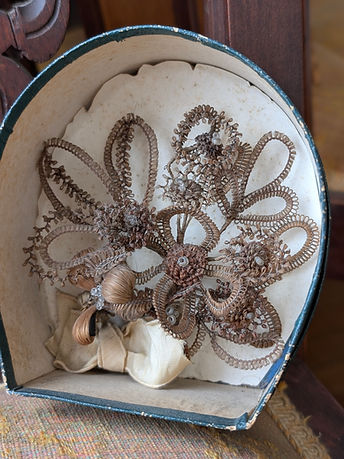
Hairwork was intrinsically sentimental. While people in the Victorian era period did use the hair of the dead people to make sentimental jewelry, it also represented the living. Oftentimes, friends, relatives, and romantic partners exchanged hair jewelry made of the giver’s hair to symbolize the importance of that person’s relationship. Hair art was not something given casually, to receive a piece one had to be incredibly close to the giver. Oftentimes, it was a privilege reserved for immediate family members and romantic partners. It was seen as giving a piece of yourself away, and people were selective about it. Hair art could also be used to symbolize relationships.(6) The hair wreath below symbolizes the relationships between a mother, Abigail Page Bailey, and her children and grandchildren. Abigail took the hair of seven children and created an intricate pattern that symbolizes the family.
Though hairwork was a keepsake, the designs could also be quite fashionable. Most hair artists prided themselves on creating hair jewelry that kept up with the trends of the time. One example of this is a brooch made out of both metal and hair, shown below. This is an example of how art can serve two purposes. First, it is a fashionable accessory that could be used in daily wear or for special occasions. Second, it serves as a memento to remind the wearer of a specific person. It is not known if this specific piece of jewelry was made as a keepsake or mourning jewelry, but when worn, it reminds the wearer of someone special. To give somebody jewelry made of their hair was a high honor and showed how one viewed their relationship with that person. When one wears it, they will not forget about this connection that is shared.

Abigail Page Bailey's family hair wreath.
Credit: Hudson Area History Connection
Hairwork was seen as a feminine practice. Men were not often making hair art nor ordering it, but rather receiving it. In the Victorian era, there was a stark divide between men's and women’s realms. Men were supposed to be the breadwinner and provide financial stability for his family. A woman's role was domestic and to make the world men live in an aesthetic place to inhibit. With that, hairwork was seen as a gift to remind men of the other realm, i.e. a world that has emotion and care at its center. It was quite common for mothers to gift their children, particularly sons, with the gift of hair art. Hair art upheld many of the strict Victorian family values. Hair jewelry could also symbolize the continuation of this rigid structure.(7) For instance, the bracelet below served as a wedding gift to a woman named Harriet. Weddings bring about change in a person’s life, but also the continuation of tradition.

Hair bracelet, circa 1817.
Credit: Hudson Area History Connection
Hair Brooch.
Credit: Hudson Area History Connection
Hairwork as Business, Post-Civil War
Hairwork had a renaissance that brought both positive and negative effects to the industry. Hair art was shifting from a primarily at-home activity to a retail mentality. Due to its sentimental nature, some people elected to make the hair art themselves, but hair was a tricky material to work with, as it was fragile and complex artwork. With that, jewelry businesses seized the opportunity and started offering hair jewelry services in which customers could send their hair to a jeweler, who weaved the hair into jewelry. Later, specific businesses that began opening focused exclusively on hair art.

Hair Receiver.
Credit: Hudson Area History Connection
Hairwork, unlike other businesses, needed very little capital to make products, as the resources to make the product was peoples hair that was different to each individual product. Patrons of these businesses would often collect hair in hair receivers, as pictured below. They would then save their hair and as soon as they had enough, they would send it out to the business to create a mutually agreed upon design. (8) So, one did not need a lot of upfront money to begin one of these businesses, which led to African Americans and poor immigrants setting up hairwork businesses.(9) The popularity of hair art created business opportunities for those who were unable to start traditional businesses.
So, these individuals did not have to get credit approval by banks, who would often deny loans for women and people of color. Because of the very little capital needed for this business, it led to black people and women opening businesses for hair art. However, this work posed a difficult problem for business owners. Valuation of hair art companies was difficult to do, as they had very little capital. Hair art needed the buyer’s hair to make the art, so the capital was given at the purchase of the product. This led to a lot of hair work companies struggling to get credit and loans from banks.(10) So starting a hairwork company was rather easy, but if one needed a lifeline for their business it was rather difficult.
Hairwork was so much more than just a beautiful object; it symbolized deep personal connection between individuals. Besides being sentimental, hair art provided a rare opportunity for women and people of color to create their own income and own companies. The Hudson Area History Connection has numerous pieces of hairwork, artifacts which display deep connections between families who have lived in the area for decades. A commission for a piece of hair art was so much more than just jewelry; it was a declaration about the closeness between two individuals and that you were willing to give up something intrinsically a part of yourself for the other person.
References
1. English Heritage, “Victorian England,” accessed April 24, 2026, https://www.english-heritage.org.uk/learn/story-of-england/victorian/ 2. Deborah Lutz, THE DEAD STILL AMONG US: VICTORIAN SECULAR RELICS, HAIR JEWELRY, AND DEATH CULTURE(Cambridge University Press, 2011), 128-129. 3. Heather Hind, Hairwork in Victorian Literature and Culture: Matter, Form, Craft(University of Exeter, 2020) 53. 4. Deborah Lutz, THE DEAD STILL AMONG US: VICTORIAN SECULAR RELICS, HAIR JEWELRY, AND DEATH CULTURE(Cambridge University Press, 2011), 131. 5. Deborah Lutz, THE DEAD STILL AMONG US: VICTORIAN SECULAR RELICS, HAIR JEWELRY, AND DEATH CULTURE(Cambridge University Press, 2011), 138. 6. Helen Sheumaker, Love Entwined(University of Pennsylvania, 2007), Prologue ix. 7. Heather Hind, Hairwork in Victorian Literature and Culture: Matter, Form, Craft(University of Exeter, 2020) 53. 8. Helen Sheumaker, Love Entwined(University of Pennsylvania, 2007), 12-14 & 88-89. 9. Helen Sheumaker, Love Entwined(University of Pennsylvania, 2007), 90. 10. Helen Sheumaker, Love Entwined(University of Pennsylvania, 2007.